




Are your frozen meals really bacteria-free? Not necessarily, according to UNSW food microbiologist Associate Professor Julian Cox.
Freezing food is often treated as a safety net, something that preserves and protects by default. But Cox says it does not undo what has already happened to food. “If bacteria were present before you put food in the freezer, they’ll still likely be there when you thaw it,” he says.
Playing hot and cold
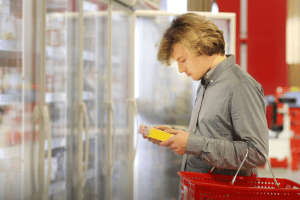
If a meal is destined for the freezer, Cox recommends cooling it in the fridge as soon as possible after cooking rather than putting it in while still hot. “Avoid putting steaming hot food straight into the freezer because you risk partially thawing the food around it and potentially giving bacteria a chance to start growing in those foods,” he says.
“Fridges handle the heat better than freezers and reduce the chance of bacteria growing on the food compared to allowing it to cool at room temperature.”
“If needed, hold food on the bench only until it stops steaming, then pop it into the fridge. Once it’s cold, transfer to the freezer.”
“You want to establish the cold chain as quickly as possible.”
“And sometimes meal plans don’t go according to…plan. Food that you thought you’d eat soon, stored in the fridge for a day or two, can still safely be frozen.”
Ice crystals and food quality

Freezing affects more than just safety. It also changes the structure of food.
“Domestic freezers can’t freeze food as quickly as industrial freezers,” Cox says. “That means ice crystals are larger, and when you defrost the food, the food structure is more disrupted, and more liquid and nutrients are released.
“If food is thawed and refrozen, this damage increases and overall quality drops significantly. It also means that thawed food can support greater microbial growth than the equivalent fresh food.”
While freezing may slow or halt bacterial activity, it does not kill all pathogens.
“Some bacteria, including Salmonella, can survive for long periods in frozen food, especially if the food is protective, for example, containing high fat and protein,” he says.
Freezing large quantities at once slows the process and can give bacteria more time to multiply. Dividing food into smaller portions allows it to freeze and defrost more quickly and safely. Cox also notes that packaging matters.
“Smaller portions freeze and defrost faster, which is safer and more convenient. Think about portions that suit your household in terms of a single meal serving. Freezer bags aren’t always airtight, so moisture can move in and out more easily.
“Sealed (airtight) containers filled close to the brim that leave little or no headspace for air, help food last longer and maintain quality.”
Thawing tricks
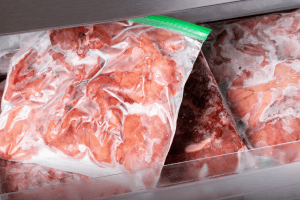
The way food is thawed also plays a major role in what happens next.
When food is left to thaw at room temperature, the outer layers warm faster than the centre. As it approaches full thawing, parts of the food can sit in the temperature danger zone between 5 and 60 degrees Celsius, where bacteria can grow quickly.
Cox says thawing in the fridge keeps food at a stable chilled temperature. Microwaving can also be used for a quicker thaw before cooking, though it may begin to cook parts of the food.
“Some people thaw in static water, but this carries its own risks as the outer layers of the food can remain in the danger zone for too long, which allows bacteria to multiply,” he says.
“While thawing under running water is an acceptable option, it certainly isn’t ideal as it requires large volumes of water, which is wasteful.
“The safest option, and that most recommended by authorities, is slow thawing in the fridge, because even after a day or two, the highest temperature the food reaches is around five degrees Celsius, or whatever temperature your fridge is set to.”
Frozen vs fresh

Freezing is often seen as a compromise on quality, but according to Cox, that is not always the case. He uses peas as an example of the phenomenon.
“By the time fresh peas are picked, sent to the retailer and make their way into a customer’s kitchen, it’s already been in the supply chain for many days.
“When you’re talking about frozen products, they’re typically moved very quickly from the field into a frozen state, so the quality is sometimes higher compared to buying fresh – and often cheaper too.”
Handle with care

Some frozen foods have been linked to foodborne illness outbreaks. In 2017, frozen berries were associated with cases of hepatitis A in Australia despite passing company testing before sale.
“Personally, at present, if frozen berries aren’t grown in Australia, I’d avoid eating them straight from the packet,” Cox says. “I still use imported frozen berries in cooking, in a range of dishes, but first I heat them up to at least 80 degrees Celsius to significantly reduce the risk of any harmful bugs surviving.
“The problem we face is that it’s very hard to detect viruses in any food, including frozen berries. So, assuming risk and preparing and cooking foods in ways to reduce or eliminate that risk is the way to go.”
With freezing being one of the most popular storage methods in Australian households, it’s important to be aware of the benefits and limitations of the process.
While freezing can certainly extend shelf life and reduce food waste, it can’t quite hit Ctrl+Z on existing bacteria.
Find more food and drink features on Crumb Wire.