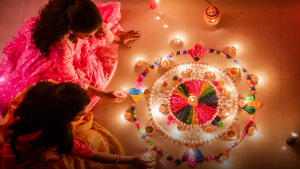





Neighbourhoods lit up with twinkling fairy lights and oil lamps, the smell of incense wafting through the air, blending with the pine-scented Aussie bush and the lactonic essence of sweet milk solids – it’s that time of year again.
As Australia grows more culturally diverse, its connection to festivals like Diwali, the Indian festival of lights, has deepened. With Indians now the country’s fastest growing diaspora, the festival of lights has found a warm welcome here – its sights, sounds and aromas spilling from homes and restaurants into the streets.
Celebrated every year on the night of a new moon as per the lunar calendar, Diwali is explained by Hindu mythology of the triumph of good over evil. The festival comes with its own set of customs, outfits and cuisines.
An unshakable pull
Diwali food is more than samosas, pani puri and gulab jamun for Indian immigrants in Australia. Flavours carry memories – of their families overseas and a wider sense of community.
For those who work in food, that nostalgia lives a little closer to the surface. Indian chefs and business owners in Australia spend their days surrounded by the very flavours that define the season – spices, sweets, snacks and slow-cooked family dishes – only to serve them to others. Diwali may not come with a public holiday here, but it still carries an unshakable pull.
Memories of Diwali
Vevek Datta, owner of Yummy Punjabi in Western Sydney’s Parklea markets, moved to Sydney from New Delhi over 20 years ago. He is celebrating the festival with a special deal on gulab jamuns this season, with Yummy Punjabi offering bulk orders at only $21 a dozen.
“My favourite Diwali memories are from my childhood – we would overload on mithai (sweets) and all kinds of dry fruit. My personal go-to was chilgoza (pine nuts). I also remember the gift exchanges with friends and family, containing boxes of chocolate, sweets and other treats,” he recalls.
“The best part about Diwali in the onset of Delhi winter was eating fresh, hot fish pakoras with my family.”
Similar sentiments are shared by Bengali joint Kolkata Social’s chef Ahana Dutt, who remembers her childhood Diwalis fondly.
“Lighting colourful candles on the balcony ledge and then waiting for the bhog/prasad. We would get khichuri in terracotta bowls from the local pandal. I also remember the smell of the toasted moong dal and ghee wafting through the neighbourhood.”
For Javed Khan, the Founder of Delhi ‘O’ Delhi, Diwali has always been one of the most special times of the year, even though growing up in a Muslim family in India, his connection to it was never religious.
“The beauty of India was that every festival – whether Diwali, Christmas, or Eid – was embraced by everyone,” he says. “It was always more about love and community than rituals.”
As a child, Khan would join his Hindu neighbours in the excitement – sitting with friends to make little cardboard houses they proudly called Diwali Ghar, decorating them with colourful diyas and candles.
He still remembers the buzz of the ‘Diwali Dhamaka’ sales, the markets sparkling with lights, and the smell of freshly made sweets drifting through the streets.
“Every home was filled with mithai in every colour and shape, but my favourite was always gujia,” he says. “Even now, the taste of that sweet filling takes me straight back to those evenings filled with laughter and friendship.”
Delhi ‘O’ Delhi will honour that same spirit this Diwali – launching a variety of limited edition Diwali menu options, including the Classic ($55pp), Premium ($60pp) or the Royale or Diwali High Tea package for $70pp.
This year, Diwali will be celebrated the world over on October 20, 2025.
Find more food and drink features on Crumb Wire.