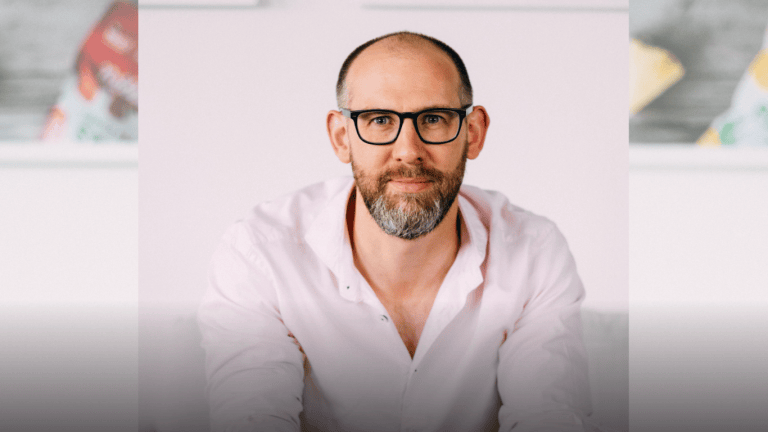





A professional cricketer, then a lawyer, then a founder: Matthew Bennett has taken an unlikely road to the snack aisle. In this Crumb Wire profile, he talks about the daughter who inspired Nibblish, sourcing quality fruit, and a business that nearly didn’t survive COVID.
Tell us a bit about yourself – what’s your background and what led you to the world of food and drink?
I actually came to food completely sideways. I played cricket professionally in the UK when I was younger, then trained and practised as a lawyer over there before moving to New Zealand. I had zero food industry background – everything I know about this business has been learned by doing.
Nibblish started because my daughter Imogen was born with a number of allergies, and there just wasn’t anything on the market that was genuinely additive-free and allergen-free that we felt good giving her. We started dehydrating fruit at home, and when friends started taking all of it off my hands, I realised there might be something in it.
Tell us about the product. What makes it unique?
Nibblish is 100% real fruit – no added sugar, no preservatives, nothing else in the ingredient list. The other thing that sets us apart is how it’s made: we gently bake our fruit rather than dry it, which is a completely different process and gives you a texture and flavour you don’t get from typical dried fruit snacks.
We source our mango and pineapple from Ghana – not because we outgrew the kitchen, but because that fruit doesn’t grow in New Zealand, so we had to go to where it’s actually grown. We spent a long time travelling and testing before we landed there, because it turns out fruit variety matters enormously to how the end product turns out. We work directly with growers on fair wages and safe conditions, and the sites run on solar power with recycled water.
Talk us through the journey of your brand. What have been some of the key achievements and challenges along the way?
We launched Nibblish at the end of 2018 but had spent about two years before that commercialising the product – finding the right growing and processing partners, getting the recipe right. By 2019 Nibblish mango was the biggest-selling healthy snack in New Zealand.
We launched into Woolworths Australia in 2021 and Coles a year later in 2022, and we’re now in more than 2,000 stores across Australia and New Zealand. The toughest period was COVID – we had a container due in September that didn’t arrive until the following February, caught up in port delays right around the world.
It took us the best part of two years to properly recover and rebuild the business so we weren’t as exposed to that kind of shock again. These days we’re selling just over six products a minute during trading hours across Australia and New Zealand, which still stops me in my tracks a bit when I think about where it started.
How has the Australian market responded to the brand and what has surprised you most?
Really strongly. Coles sales are up 48% and Woolworths Australia is up 33% year on year, and about half our range now sits in the top quartile of performers in Woolworths’ Healthy Snacking category. What’s surprised me most is how much the brand has resonated with Australian shoppers.
Consumers understand that something that’s genuinely just fruit, with nothing else in it is better for them. I think people are more label-literate than they used to be, and once they flip the pack over and see there’s nothing to hide, that does a lot of the selling for us.
What is one thing you wish more people knew about the work you do?
How much thinking goes into sourcing before a single piece of fruit gets baked? People assume we went to Ghana to scale up production, or because it’s cheaper but it’s the opposite – the fruit needed to come from where it actually grows well, and the variety that grows there is critical to the particular process we use to bake the fruit.
Different varieties from different regions behave completely differently once you start processing them. We tested for a long time – there was a period where I was shipping fruit samples all over the world just to compare varieties and partners – before we found growers who were willing to buy into what we were trying to build, not just take an order. That relationship is the foundation of the whole business.
How do you see food and drink culture in Australia evolving and how does your brand fit in?
I think Australian shoppers are moving away from the idea that eating well means sacrifice. People don’t want to be told off about what’s in the pantry – they want permission to feel good about an easy choice, without it feeling like punishment.
That’s exactly the space we’ve built Nibblish for: it’s not a diet snack, it’s a nourishment brand. We’re not trying to be extreme or preachy about it – most of our customers are having a Nibblish and something far less virtuous in the same day, and that’s fine by us. As long as fruit becomes an easier, more obvious choice more often, we’re doing our job.
What keeps you inspired as a founder?
Honestly, it still comes back to Imogen and the original reason we started this. Every time I see a mum picking up a pack because she wants something she can hand her kids without a second thought, it reminds me why we did this in the first place.
Beyond that, it’s the growth – watching something that started on my kitchen bench end up in thousands of stores, and now looking at markets like China, keeps me energised. There’s still so much building left to do.
What’s next for you and the brand?
We’re in the advanced stages of entering into China and some other Asian markets, with fruit range designed specifically for those markets. We’re being very deliberate about it – particularly on the consumer research and regulatory side. Closer to home, we’re continuing to grow really strongly with our retail partners across Australia and New Zealand and pushing into more specialty and independent grocery. Longer term, Asia is a big part of where we see this brand going.
And finally, what do you like to do when you’re not at work?
I play golf, although I get out a lot less than I’d like to these days. Outside of that, I love reading and travel, but only for pleasure, not work.