



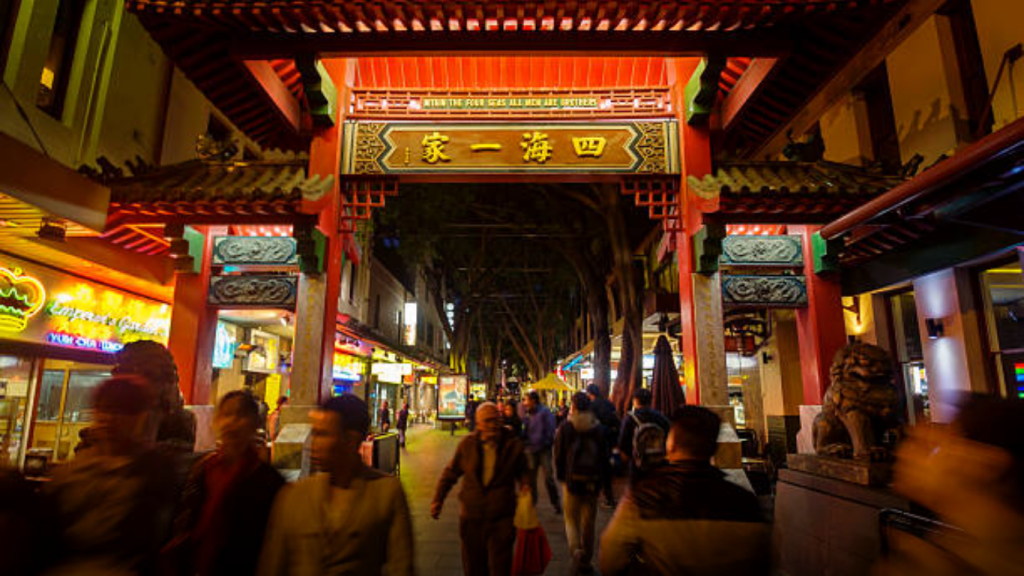
Every year, as Australian universities fill back up, so do the streets around Sydney’s Chinatown. New students, new money, new appetites and a neighbourhood that never stops evolving.
International students have long been a driving force behind the evolution of Chinatown, but their influence goes well beyond filling restaurant seats. According to Kitty Lu, Director of Public Affairs at HungryPanda Australia, a food delivery app specialising in Asian cuisine, they function as both cultural carriers and economic engines.
“International students play a uniquely dual role in reshaping Australian Chinatowns – they are both cultural carriers and economic drivers,” Lu says.
“Rather than preserving a static version of Chinatown, they continuously refresh it – introducing new regional cuisines, dining habits, and even social ways of engaging with food.”
It’s not just about what they eat either. Many international students are also part of the ecosystem as workers, entrepreneurs and operators, meaning they are shaping supply just as much as they are driving demand. “This creates a highly dynamic loop where international students influence what is consumed, what is created, and ultimately what Chinatown evolves into,” Lu adds.
Chinatown beyond the postcode
The pandemic changed things permanently for Chinatown’s food businesses. Traditionally reliant on foot traffic and dine-in, many were forced online during COVID and never looked back. Lu describes that period as a turning point rather than a temporary fix.
“Access to diaspora foods has expanded far beyond the physical boundaries of Chinatown,” she says. “Consumers no longer need to travel into the city – they can now discover and order highly specific, authentic dishes from anywhere, often driven by online search and social media.”
For merchants, that shift opened up entirely new audiences. Small, traditional businesses that once depended on local regulars can now reach customers across the city, and increasingly, digital marketing and customer engagement tools are proving just as important to growth as logistics.
What people are actually ordering
The data coming out of HungryPanda, whose catalogue spans Asian cuisine broadly across Chinese, Japanese, Korean, Thai and beyond, points to a rise in demand for regional Chinese cuisine specifically.
According to Lu, Sichuan and Hunan have been growing steadily, Northeastern Chinese is gaining ground with an emerging interest in Yunnan and Xinjiang flavours, dishes that until recently were hard to even find in Australia.
Lu attributes a lot of this to younger consumers who are “more open to exploring beyond familiar, westernised versions of Chinese food,” adding that “consumers are not just satisfied with convenience – they’re actively seeking out more niche, authentic, and even lesser-known dishes.”
The phenomenon is not limited to Chinese-Australian diners either. “Mainstream audiences are becoming more adventurous, often driven by social media, peer recommendations, and increased cultural exposure,” Lu says.
Fusion and modern interpretations are sitting alongside traditional regional dishes rather than replacing them, reflecting a consumer base that wants both authenticity and novelty at the same time.
Based on the current trend, students arriving now – once they’re done processing everything they learnt at orientation – might just put another thing or two on all our tables by this time next year.
Find more food and drink features on Crumb Wire.